Monday, October 31, 2011

Written vs diagram patterns

It seems a curious aspect to British knitting (and crochet) patterns that they are nearly always written out long-hand. I once spent a year working on a Debbie Bliss pattern (her patchwork cable cardigan, which was a selection of four different cable patterns in various positions) – and the first thing I did was to chart out the cables. Bearing in mind, the simplest cable was a 4 row repeat, and the most complex one was 16 or 20 rows. I don’t quite understand why British publishers have such an aversion to using a method that is (a) universal, regardless of language and (b) takes up much less space. The same goes for complex lace patterns – a chart is so much easier to follow.

I much prefer American crochet patterns where diagrams are used – T for a UK half treble, T with a slashed trunk for a UK treble etc. It means I can forget mentally converting from US to English crochet terms in my head and just get on with it.

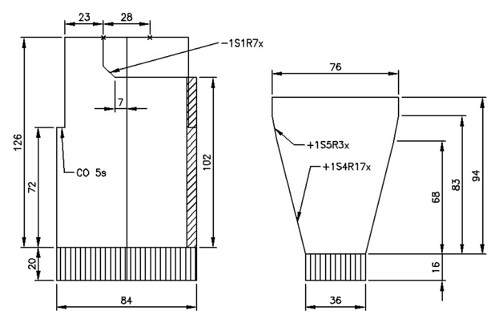
It also helps no end to have a dimensioned diagram of the finished item. Machine knitting patterns always have dimensioned diagrams, so that those of us with a knitleader can use the same pattern with a different yarn (or even a different machine). Rowan patterns usually have a basic schematic – it’s useful to have something to refer to when blocking the garment to size.

Two favourite machine knitting publications (both now defunct) used pattern diagrams as the main means of communicating a pattern. I’m referring to Modern Machine Knitting and the Passap model books. In both cases, I imagine it was partly to save space, and partly so that the publications could be communicated to a wider audience, not all of whom would be native English speakers.

The first thing I do, having calculated a new pattern in Knitware? I sketch the pattern out as a schematic, and transfer the shaping details to it. Takes up a lot less space and is much easier to follow, especially if you get interrupted part way through. MMK had a similar schematic - except on the right, they'd put row and stitch measurements, and on the left, measurements in cm. So you had the best of both worlds on the same diagram.

This was my design for a waterfall cardigan. As discussed in the previous post, I didn't think the front was very successful so it got frogged. This is the kind of thing I draw up to work from. I guess I'm just a visual person. I also add row counts after each batch of decreasing/increasing - it's useful to have a check figure.

design

Assembly diagrams are also a good idea - the Rebecca cardigan being a case in point. It took me much longer to sew it up (aprox. six hours) than it actually did to knit it!

What do you prefer - written instructions, or a diagram pattern?

Productive weekend

Well, I had grand plans to make one of those waterfall tops with the leftover Marble chunky, but although I calculated a pattern using Knitware (based on a round-necked jumper but with wrap-over fronts), I only knitted the back and one front before deciding I just didn't like it. Although I'd done the open edge of the front as six stitches of 1x1 rib, it still curled, and I don't think it would have hung properly. I'm not sure a chunky yarn - well, this is an aran weight - is ideal for something like this, and I think the front would probably benefit from being a 2x2 rib, which means it would need to be recalculated anyway. So it got frogged.

Instead, it became a child's v-neck cardigan (calculated in Knitware), an adult hat and a child's hat, and another charity tee jumper - and I've still got more of the stuff left! It goes a long, long way, this yarn, and is very good value for money. With both hats I substituted the hem (or lack of one) for ribbing. I never find hems sit that well (although I MUST try Erica Thomson's technique of picking up every other stitch over two rows), and the rolled brim look just makes me think of condoms - yes, I have a dirty mind, apparently.

Pictures of projects will be posted when I have actually taken some, haha.

There's probably at least enough of this yarn for another child's hat I think. I've also got almost two balls left of the lilac DK to do something with this week.

Monday, October 24, 2011

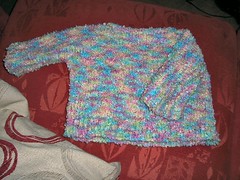
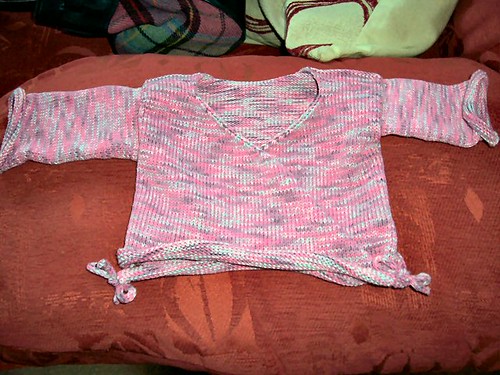
FO: Another charity tee


100_2288
Originally uploaded by steel breeze

Very pretty loopy yarn picked up at a show years ago, completely evil to knit with. It has tucked slightly, hence the rather cropped length. The remainder is going in the destash bag - never again!

FO: Rebecca


100_2290
Originally uploaded by steel breeze


100_2291

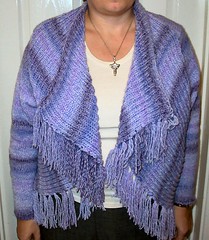
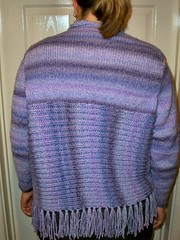
Fairly easy to knit, complete nightmare to sew up - took three attempts to get the sleeves in correctly. I think a diagram might have helped the pattern no end. The words made no sense so I sewed it up to look like the photograph. It's very warm and smooshy, and it needs a button adding.

Wednesday, October 19, 2011

Scrumptious

Well, I had a fantastic (if busy) day at the annual Long Buckby Knit and Natter day. I was supposed to be teaching chain-free (aka foundation) crochet, but the tunisian lady, already advertised. couldn't come, so I ended up with that as well. When I got there, there were two massive tables pushed together, far more than I could reasonably shout across. I spent a very hectic morning teaching Tunisian, foundation and ordinary crochet, sometimes at the same time. People were still coming up to me at 12:30, by which time I was packing up. Methinks there's a great need for crochet classes in the Midlands. Maybe something I should think about, although I would only rate my own skills as intermediate. After lunch we had a fascinating talk by Iris Bishop. Although I had heard/seen some of it before, she always makes it inspiring. She seems to be going in for glitter and sparkles lately, should we worry?! :D

Accidentally (yeah, who am I kidding?) I managed to snatch ten minutes to buy 7 balls of James C Brett Marble DK in lilacs from the Uppingham's stand, and had planned to buy two balls of Zauberball sock yarn, but had used up most of my cash so had to put one ball back. I've already started using the Marble DK, I bought it specifically for the Karabee Design's "Rebecca" cardigan pattern that I bought at Dream Week. It's a cardigan made up of a long strip of fisherman's rib which is draped in a way I haven't quite figured out yet, with fringing (which I might leave off). It has a kind of shawl collar.

It took me three attempts to get the rib started correctly - it's not easy picking up dropped stitches in Fisherman's rib, and the drapey part has a pointed edge. I love the feel of the fisherman's rib though - I've never made a garment with it. It feels scrumptious and makes the yarn feel more airy/fluffier than it really is. It is knitted at T5/5 on the Brother KH260 - I would normally knit DK yarn at T4, but that's just my personal preference. Knitted the main body last night - himself has a cold and isn't feeling up the gym so it became a good excuse to duck into my knitting nest. Just got the sleeves to knit - they are fairly straightforward. I also started to get the dreaded static - this seems more of a problem in the winter, despite our heating not yet being on. Decided to follow my own advice for once and RTFM - and the manuals suggest a lot more places to oil than I've ever bothered with. Made heaps of difference! Waxing and spraying the yarn with water/silicon didn't seem to help that much. I have one of those Ballistol oil pens from Metropolitan and they are really easy to use.

When this is done I need to use up the rest of the blue Marble chunky - I have a plan, based on a Knitware pattern. We shall see!

Monday, October 17, 2011

Some FOs

Lilly wrap for a charity shop:

100_2276

I was without a ribber whilst making this - Thomas the cat having used my ribber carriage as a trampoline - so the hems are latched for about 5 rows. Didn't get time to wash/press. I know ribbed welts are considered somewhat passe, but at least they stop the curl!

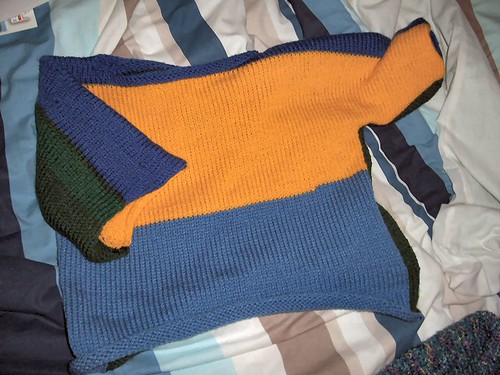
Charity tee top made on an LK150:

100_2277

Made this on Heritage weekend in September, only just got around to finishing it. There's another half somewhere but I am out of DK at the moment and the mid-gauge has been taken down.

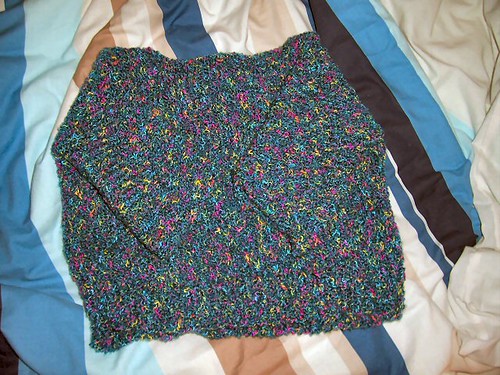
Charity tee top made on my KH60:

100_2278

This is a skein of very pretty blue boucle yarn that I bought as a four pack ages ago (the other skeins were all different). I had planned to use it for myself, but there was not enough for much more than a hat. This used most of the ball - someone else can benefit from my impulsiveness.

The charity tee top patterns are based on the Guideposts knit for kids pattern and they are linked on my Free patterns page.

Friday, October 14, 2011

Tuesday, October 11, 2011

Calculation breakdown

I've almost finished knitting a short-sleeved v-neck sweater in the beautiful blue Marble Chunky I picked up at DW 2011. I used a preset size in Knitware, and I weighed my swatch, in order to calculate whether or not I had enough yarn (I only have 500g). Well, I've only one sleeve left to knit, and yet I've 200g left over. Not sure now whether to carry on with the design, bearing in mind I've done the front/back and v-neck ribbing, or whether to rip it out and start again. Not sure how come the weight calculation was so off - by my calculations, I should only have had enough for three quarter length sleeves. Knitware is usually spot on when it comes to calculating yardage, so not sure where I went wrong. I've only one more sleeve to knit, and it is only 34 rows in total.

Looking at what is left, I could have long sleeves and still have enough for a matching scarf and hat. Decisions, decisions. The yarn is plied from two colours which are variegated - so there is indigo, green and purple in amongst the blue, which is a sea blue itself. Being variegated means I am less keen to re-knit it too often as yarn changes will be obvious.

I tend to get quite hot when wearing jumpers (especially long-sleeved ones in acrylic) so perhaps I'll leave as is - it's more likely to get worn with short sleeves. The irony is that the winters here are usually mild enough that jumpers are rarely worn - doesn't stop me knitting them, of course, but it does mean that the local charity shops often benefit from my work. I knit them for the fun of the process but do not always like the end results. I do have another 1000g of this yarn in a pastel colourway - most of it is currently a crocheted top which is far too warm to wear, so needs unpicking. I'm thinking (seeing as I still have the tension details for it) that perhaps that can become some kind of waterfall cardigan, because there is more yarn to play with.

Of course, the last two winters have been very cold and the cold weather went on 'til May this year (at least, that is when it warmed up enough for us to turn the heating off at home) so perhaps the trend is for cold winters for now. An excuse to dig out and wear my jumpers at last! Cold is relative, of course - I'm sure my friend in Finland will think our winter temperatures pretty balmy. Last winter's record for us was minus 7 centigrade, I think.

The Dream Week cardigan is in a kind of limbo at the moment - when it is washed, the ribbon part pulls up - so it's like one of those ruffle blinds that were all the rage in the 80s. Luckily it's not permanent shrinkage, but I'm thinking I might need to do some more tacking down with the sewing machine. Or never wash the thing. One or the other! It seemed like such a good idea at the time. Oh well, never mind!

I've plans to start swatching with some lovely Peaches 'n cream worsted cottons, too. I've made a few nice things with the cotton - a top for my niece, a peg bag, a shopping bag or two, but not gotten around to making anything nice for myself with it. It seems to go quite a long way so hopefully there'll be enough to cover my ample curves. I'm trying to get my stash down a bit. Yes, I've said that before. Ironically, I still don't seem to have the exact yarn thickness or colour when I want it. Funny, that!

Thursday, October 06, 2011

The Amazing Passap Neck

Went to our third Passap meeting last night. The theme was how to do the famous "Passap" neck. I've seen it described in print a few times, but never quite understood how it worked. Being a doofus I don't seem to have brought the beautiful sample home with me in order to photograph it (which means I shall have to have another go at it).

The principle is as follows:

1. Hold the neckline (or edge to apply band to) against the machine and estimate the number of needles required when it is slightly stretched. 

2. Put that number of needles into work on both beds (or set up for whatever rib you require - we did FNR or K/K). 

3. Cast on and knit the band rows (we knitted 20). * 

4. Knit 3 (or an odd number) enclosing rows on the back bed only, ie N/GX 

5. Knit the same amount of enclosing rows on the front bed only, ie GX/N 

6. Place the item requiring the band, right side uppermost, with the neckline along the needle bed and the rest of the garment draped down the back of the machine 

7. Using the single-eye transfer tool, pull each back bed needle through the garment piece JUST ENOUGH to clear the latch 

8. Rack the machine slightly so that the front bed needles are almost opposite the back bed needles 

9. Using the double-ended bodkin, place each front bed stitch onto the corresponding back bed needle, and pull the needle fully out this time. 

10. Fiddly bit: Draw lots of yarn through the feeder and anchor it somewhere to stop it springing back.

 11. Working from one end, lay this yarn into each latch hook and close the latch on it (pull the back bed needles downwards to just close latch). 

12. When done, the yarn should slide freely along the length of the knitting. Hang the left hand end over the racking handle so it can slide freely 

13. Using a spacer (someone brought a spacer that was a 13mm wide strip of plastic), and working from the right hand end, knit each back bed needle back so as to hit the spacer. 

14. This now encloses the garment edge between the rows knitted in (4) and (5). 

15. You can now open the beds and drop the garment down between them 

16. Cast off loosely.

*If you've done a needle out rib eg 1x1 now is a good time to bring those empty needles into work and knit two extra rows FNR or K/K

You can change the amount of rows used in 4 and 5, as long as it is an odd number. P recommended 5 rows for a cut and sew edge, and 3 for a shaped edge. The finished result is very neat and the cast off edge is on the inside of the garment.

This kind of band is very useful for cut and sew garments, which is especially good for Passap machines as there is no holding position as such (just slip) and for complex double-bed patterns, slipping stitches is awkward, slow and prone to error. Far quicker to knit two backs and deal with the neck later. You can also use this to edge other things e.g. P had done one of Norman Whitfield's pillowghans (a pillow stuffed with a baby blanket that is attached to it). She also brought some lovely tops and some handknitted dresses where she'd applied a scalloped edge with this method.

There is no reason you couldn't do this on a Japanese machine, either. It's time-consuming and a bit fiddly, but the result is worth it.

I had a lovely meeting and now I can see what the books are talking about. After that, we had refreshments and got to have a look through a lot of Passap-specific books and patterns that someone had donated. I finally got a copy of Passap Model book 3, can you believe it? Been on the lookout for that one for forever.

Nightmare drive back home, though - they'd decided to close the M5 at junction 1 (and I'm not sure where the diversion was supposed to go, but I didn't fancy an extra 20 miles in the wrong direction) so I drove through Handsworth and got back on the motorway at Spaghetti. Then we came to a complete stop (both sides of the M6) at J2 for pedestrians (!) on the carriageway - I should point out it was dark and raining. Nothing to see when we got going again, no idea what that was all about. Took me an hour and fifteen minutes to get home - himself was trying to decide if he'd time for another beer as I was picking him and his brother up from a German night at the pub, and had texted me whilst I was driving - duh, not checking texts whilst I drive 'cause 9 times out of 10 it's Facebook! I had my hands-free kit on, but there's no way I'm checking texts at 70mph on a dark and wet motorway.

Not getting much machine knitting done at the moment, because I'd need to actually be at home for that - I did find a bit of time to get my Brother KH260 chunky set up and pack the midgauge away, but that's as far as I got on Sunday. I have a bit of time Saturday afternoon I hope. Tonight I'm planning on going to the Manor House machine knitter's meeting in Leicester.