Thursday, June 30

How to handle a major de-stash or estate sale

Well, this is the second one I've done now, so I thought I'd impart some of my wisdom in the hopes it might help someone else.

1. Spreadsheets are your friends. Split the stash into yarn, machines/accessories, and publications, and have a fourth tab to keep track of the money
2. All the yarn must be photographed, weighed and inventoried. This is best done directly onto the spreadsheet if possible - especially if (like me) you have bad handwriting!
3. If at all possible, sort the yarn out first so that all the cones/balls of one colour are in the same bag (I missed this one this time!)
4. Photograph as many cones at once as you can, and arrange them with clear colour contrasts. Each bag might need several pictures.
5. Designate each bag with a number, and label each bag with it (or in my case, pop a piece of paper with a number on it in the bag). It also helps to identify the bag by its colour or if it has a logo (charity bags are excellent for this).
6. When inventorying knitting machines, print out the "this machine comes with" page, so that you can visually check off all the bits that are present or missing. Do this for any item that has several parts, and keep the checked print with the items (plastic totes are great for boxless machines).
7. If someone asks for a lucky dip, £x amount of yarn, save your legs and work out which ones they'll get from the comfort of your armchair.
8. It's important to have a money tab, because buyers may want a mix of yarn, books and accessories, and it otherwise makes it rather hard to track between tabs who owes what and for what item
9. Don't rely on mental arithmetic at 11pm at night. It's not worth the hassle!
10. Don't forget Paypal and Ebay charge a fee; make sure you subtract that from the total raised.
11. Use a courier quotation service eg Parcel2go for the larger boxes - Royal Mail isn't cheap for large items.
12. Make sure you have lots of empty boxes, jiffy bags and parcel tape to hand. You have to weigh the packed item to give the buyer the final price.
13. Try not to curse if the buyer changes their mind and you have to reopen the package! :)
14. Make sure you put the weight and the recipient on the parcel. You may have more than one to send at once.

Still drowning in yarn but it's going down slightly. Next stop Ebay I guess.

Wednesday, June 29

Thomas


thomas jun10
Originally uploaded by steel breeze

(this is an old pic) Thomas is not well, I don't think he's eaten since Sunday. He's moping about and seems lost, and if I offer him food he just starts vomiting up saliva :(
Vet could find nothing yesterday, taking him back tonight to get blood tests done and possibly an X-ray. He's only 10, too young to leave us yet! :'(

Thursday, June 23

Massive estate sale - acrylic yarn

I'm not one for advertising, but I have 11 sacks of coned yarn (mostly acrylics, some fancies) to shift for a friend who is giving up machine knitting.

Spreadsheet here, photos here - paypal only please. Any sensible offer accepted. I will make you a lucky dip bag if you tell me the total weight and preferred colours. For those outside the EU, postage above 1kg gets expensive and will require a box - please bear this in mind.

Almost FO: boa scarf


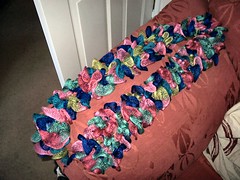
boa scarf
Originally uploaded by steel breeze


Rico Can Can, 5mm needles, 7 stitches, garter stitch. Needs ends sewing in. Making a smaller one with the leftovers.

Wednesday, June 22

The grump

Well, believe it or not I've been too busy to do much knitting lately. I've made one boa scarf from the Rico Can-can and am knitting another from the remainder. Probably shouldn't have cut the yarn on the first one. Probably should have weighed it so that they both use exactly half the yarn weight. Hey ho, hindsight is a wonderful thing, no? Not felt up to much lately. Having some health issues which are making me moody, snappy, hypersensitive, stressed, and grumpy. I'm sure the Cog would say I'm like that all the time, but I don't think I am. Not been sleeping well - have invested in new pillows and blackout curtains. So much to do at the moment, my mind is still too busy to sleep at bedtime, which is no fun for anybody.

Saturday I attended the annual Machine Knitting Guild AGM in a tiny village called Newton Regis, near Tamworth. It was lovely to see familiar and new faces. The competition entries were on display - the one I liked the best was a garment (I think it was a cardigan?) made in sections, with free-motion embroidery over the "slashes", I presume some sort of dissolvable interfacing was used. I don't think it won though. Ann introduced me to some other Passap owners who are thinking of starting a club, they are west of Birmingham so not too far away from me to join if they do. We had an interesting talk from a PhD student who showed us lots of ganseys made for ex-boyfriends (all of which had rude names in garter stitch) and some excellent lace wall hangings she'd made on knitting frames like the ones at Ruddington. I may have accidentally bought some coned cotton from Uppinghams. It was variegated and pretty. I'm only human.

Sunday I went and did a "garage clearance" for an ex guild-member. I didn't think to ask, on the 'phone, how much they had - turned out I'd filled the car almost to bursting (couldn't fill the passenger footwell because the Cog was with me), so had to go back for the rest of it on Monday. There are four Brother knitting machines, lots of paraphernalia, two stacks of books and 11 refuse sacks of yarn (mostly acrylics), half of which are taking up space in my tiny dining room area. I need to inventory that lot tonight, because I've got company coming on Sunday and there's no way I can get four people around the table at the moment. Last night we had a major tidy up downstairs in preparation. As long as nobody looks in the office, the bedroom, or the knitting room, we look like a tidy household! I also need to get the machines at least together to be sold - the accessories are all in boxes, and the ribbers have no boxes, so not sure if everything is complete yet. I do wish people wouldn't chuck their ribber boxes - they have polystyrene inserts for everything, so you can tell at a glance if you are missing anything. Not having a box makes things so much harder to post, too. I have a fine gauge ribber at home with no box, currently out of use, and I don't like it not being stored properly, that's how brackets get bent.

Onwards and upwards through adversity!

Thursday, June 16

I can can-can, can you can-can?

Quick update. Handknitting mojo has gone a bit AWOL lately - stress and some health problems contributing to my rather grumpy mood at the moment. So the pompom sock has stalled in favour of a fast fix - a boa scarf in Rio Can Can. The yarn is a kind of mesh tape and you knit into the top edge of it (instead of using the whole tape). Just plain garter stitch over 7 sts makes ruffles and is very effective.

Behind the scenes, I am swatching away for a secret machine knitting project. Ok, no secret, it's for this year's Metropolitan Dream Week challenge. I'm sure I shan't win, but there's no need to give the game away 3 months in advance, so don't expect any photos for a while. :]

Also knitted the third panel of the intarsia waistcoat. It's not getting any less loud. I am going to look like Joseph of the musical, but with less style, I suspect. No change there, then! Ha!

Tuesday, June 14

Drafting a skirt block

I had a great time this weekend. I spent the weekend doing a 2 day course at the English Couture company in Syston, which is north of Leicester. We had a bit of a giggle measuring each other (there were three students) and then drafted up a skirt block for ourselves and made a toile, and then adjusted the skirt block. This was based on the very good Winifred Aldrich book, which is very easy to follow. I managed to mess up the sewing machine (it was a very scary one with a computerized display) and I spent an hour adding some fabric to the wrong half of the skirt, but we got there eventually. I've since drafted the finished block up in CAD - found an excellent free 2D drafting program called Draftsight by the same folks who make Catia. Seems to work exactly like AutoCAD so I had no problems in using it. We also had a go in designing our own patterns using the basic block as a template. Great fun!

Now I want to use the measurements to draw up some other standard blocks. There is also going to be a trouser and a bodice class this year, which I may well sign up for!

Alas, it meant I missed National Knit in Public day. I'm hoping the girls had a nice "indoor" picnic at Mrs Ts! :)

Tuesday, June 7

Some things in progress...

100_3912
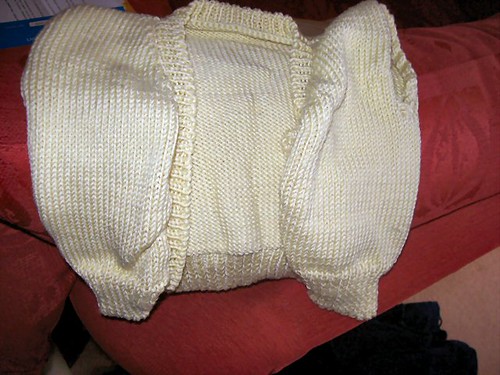
Baby waistcoat in bamboo. Just needs some press studs sewing on.

100_3911
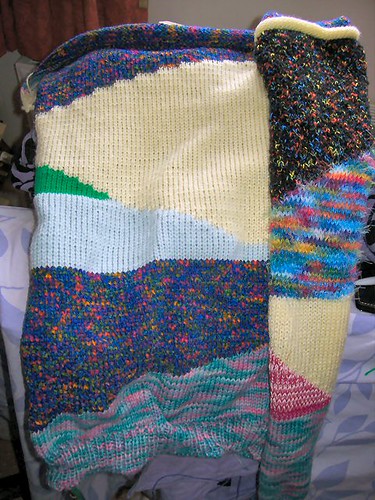
Intarsia waistcoat for me, back and one front.

Although I've not exactly lost my knitting mojo lately, work's been very, very busy since May Day and I've hardly had time to get into the knitting room (apart from dealing with the tumble dryer - yeah, Mount Washmore never seems to go away!). When it's quiet at work I get bored and demotivated but I have more "head space" in the evenings/weekends I suppose. When it's busy, my concentration is somewhat compromised. Spent a quarter of my weekend getting my hair done - no particular reason, it just desperately needed recolouring and a good cut - and the rest of the weekend re-organising the Machine Knitter's Treasure Chest website. Next weekend I'm away on a sewing course all weekend, so not much chance of getting machine-knitting then either.

And... I'm a bit grumpy at the moment. Not sure why. Himself is grumpy too. It must be catching!

Saturday, June 4

Buying a second-hand knitting machine

There's quite a healthy market in used knitting machines online. It's very easy to pick up a second-hand knitting machine without realising quite what you might be getting into. So I thought I'd write a post based on my past experiences, in the hopes it might aid someone else to avoid some of the pitfalls.

Vintage machines

Old knitting machines never die, they just end up in the attic or under someone's bed. These machines (and by vintage, I mean circa 1950-1960s or earlier) are very well made - mostly from metal. However, they will be lacking in later innovations. Early machines did not have tension masts (some had them attached directly to the carriage). Early machines often did not have sponge bars, they may have had metal strips instead. They may have a different way of handling the yarn, eg moveable sinkers and static needles. They will not be able to do automatic lace (using a lace carriage) because their needles are too stiff. Vintage machines often used non-standard gauges, eg 5.5mm. In all cases, it will be very hard, if not impossible, to purchase spares for these machines. They will no doubt knit beautiful stocking stitch, once you get them working. But the yarn tension may be an issue, and any patterning you might want to do will be done by hand. Slip, tuck, fairisle, lace etc are not impossible on older machines, but they are more time consuming. These items are of curiosity value only, and should be priced as such. Alas, sellers often charge too much - the machines are not really worth much unless you are a collector, but you will often see vintage machines going for lots more than their original selling price online (bearing in mind they were sold pre-decimalisation too!). How much would you pay for a 60 year old car, unless you were a collector?

Things to ask:
  • Does it have a tension mast?
  • Can it do any automatic patterning?
  • Can I still buy spares for it?
  • Is it a modern gauge so that if I buy small accessories from another brand, they will still work? (Modern gauges are 3.6, 4.5, 5, 6.5, 8 (USM) and 9mm).
I have nothing against vintage machines, as an engineer I find them fascinating to look at. Mark at Metropolitan has a fascinating collection - he usually acquires them when they are donated to him for free. I would, however, miss the modern innovations later machines offer.

Damaged or incomplete goods

Most knitting machines and accessories came in convenient carry cases and boxes which had places for all the parts, but even so, over the years things can get seperated. Make sure you scrutinise any pictures and check that you can see the main parts, and that they are in good condition. With the exception of Silver/Knitmaster (aka Studio, Empisal), knitting machines are no longer manufactured. Whilst some spares are still available, replacing parts or major items such as carriages can be very difficult and very expensive.

Things to ask:
  • Can I see the carriage / tension mast?
  • Are all the parts present and correct?
  • Is there a manual?
  • Are any items damaged?
  • Is the bed flat (ie has it been dropped)?
It's always worth asking the seller to check the manual if available. There is a pictorial list of what should be with the machine at the front. Small items such as transfer tools, needles etc can be replaced (see note about gauges above), but a knitting machine without its carriage is just a large metal doorstop. Cracked or damaged plastic can indicate the machine has been badly treated. A bent bed is useless.

Dirty or rusty goods

A grimy machine isn't always beyond redemption - oil attracts dust but can be removed with care (surgical spirit aka denatured alcohol is the best). Surface rust on needles can be removed by soaking overnight in a solution of strong tea. However, deep rust is beyond redemption.

Postage and packing

It's always advisable to pick up the machine yourself if at all possible. You can check over the machine for damage and missing parts, you can see it working, and you can always back out if need be. If it's not possible to collect in person, you must insist the seller packs the machine very, very well. The original boxes, plus lots of bubble wrap, plus a strong plastic bag. It should look as if it'd bounce. Parcels travel on conveyor systems up to the length of about a metre, so if the seller can cover it with "manual handling only" stickers that might help it to arrive in good condition (presuming the seller can be bothered - despite my offer to pay extra, I still took delivery of a damaged machine). Parcel conveyor systems use waterfalls - drops between each conveyor - and sometimes the handling can be careless - so your machine should be packed to withstand being dropped. It's worth paying extra for packing, or making the trip to get the machine - you could always make it into a short weekend away, perhaps?

Gauge

Think what gauge of yarn you want to knit, and purchase accordingly. Standard machines (4.5mm) are the most widely available - but the "standard" yarn thickness of the time was akin to today's modern 4ply. If you want to knit with thicker yarns, you should look for a midgauge (6.5mm) or chunky (9mm) machine.

Construction

There are machines with plastic beds and metal beds. Plastic beds are great for beginners but they rarely come with matching ribbers, and patterning is always by hand. The LK150 is a lovely starter machine, as were the Brother KX machines (one of which is even convertible). I never got on with the classic Bond (aka USM/ISM) - the bed is in sections and was never flat, the carriage kept falling apart, and there was no tension mast. But some people do wonderful things with them. If you can afford a metal machine, you will outgrow it less quickly. As with a computer, try and buy the best you can afford.

Selecting a machine - base specification

This is the minimum specification I would look for:

  • Overhead tension mast (looks a bit like a tv antenna)
  • Some kind of automatic patterning - punchcard is ideal, electronic is best, 4 or 8 button at the very minimum
  • Ability to add other accessories in the future, eg a ribber, a lace carriage, an intarsia carriage
  • Made by the "big four" - Toyota, Passap, Brother or Knitmaster - these were the most common so spares availability is better.
If you are completely new to machine knitting, I would avoid Passap first time around. They are lovely machines, but they are fixed double beds and they can be harder to learn because you cannot see if there's an error. Their patterning is different and there is less information available for them. I would always recommend starting with a single bed machine and then getting to know the ribber once you are comfortable with the main bed.

As regards model numbers, I can only speak for Brother as I don't have as much experience with the other makes. The Brother 710 is my minimum spec (it has 8 button patterning), the early 800s used a quirky sideways punchcard arrangement, which is actually quite handy for on-the-fly designing. The KH836 upwards are proper 24st punchcard machines - they use a roll of stiff paper or plastic, not dissimilar to the organ roll in an old-fashioned pipe organ. The KH900 series are the electronic versions - they work well as long as the electronics are in good order. If not, you'll need an electronic engineer to be able to fix them.

Finally - don't let the red mist descend and pay over the odds for something if you're not sure about it. Post a link to it on the main MK group on Ravelry, and ask other people to take a look for you if you are not sure. They can tell you if it's a good deal or an old crock. I use an auction sniping site (Auctionstealer) to place bids on Ebay. It means I place a sensible bid and then I forget about it - if I don't win, it wasn't meant to be, and I don't get into a bidding war for more than I want to pay.

An honest seller will be happy to answer questions and help you with your purchase. However, a lot of knitting machines are sold off as part of estate sales, and darling nephew has no idea what he's selling sometimes, nor what he ought to charge, so caveat emptor.

Happy shopping!