Showing posts with label machine knitting. Show all posts

Sunday, June 28, 2026

Getting started in machine knitting

Machine knitting can be quite daunting to the uninitiated, and it can give us "old hands" a run for our money at times too. I thought it was high time I wrote a post for those thinking about dipping their toes into this most interesting of crafts.

Introduction

Most knitting machines ceased manufacture in the 1980s and 90s, with the exception of Silver, Creative and Artisan brands, but that does mean you can pick up something second hand of decent quality on Ebay or Facebook. Buyer beware: very vintage machines (before 1970) can be hard to get spares for. Anything from the 80s onwards is a good bet, and Brother were the most prolific sellers in the UK. Useful reading about on buying a second hand machine. Try and buy the machine in person if possible (and ask to see it working is even better). They don't travel well in the post, and unfortunately not everyone online can be trusted to sell you a working machine. Your local guild or club (if you have one) are often excellent sources of preloved machines. 

Choosing your machine

Buy the machine for the yarn you most wish to use, and don't try forcing too-thick yarn through a machine - you'll only end up frustrated, and possibly damage plenty of needles in the process. In this case, the machines are approximately grouped as follows (ideal is knitting plain stocking stitch):

  • Fine gauge - 3.6mm pitch, up to a 4ply (ideal yarn is 3ply weight)
  • Standard gauge - 4.5/5mm pitch, up to a light DK (ideal yarn is 4ply weight)
  • Midgauge - 6-7mm pitch, up to aran (ideal yarn is DK weight)
  • Chunky gauge - 9-11mm pitch, up to chunky (ideal yarn is aran weight)
Obviously there's wiggle room either side of the "ideal" yarn weight, and yarn weights are notoriously vague. For more on this, see this useful article. 

Yarn

Whichever machine you decide to pick, the yarn MUST be prepared in a format that feeds easily to the machine, because these babies use yarn FAST. So pulling it directly off balled yarn, either from the outside or the centre, just will not do. Invest in a ball winder - they're inexpensive, and will save you tears and frustration. If you are only using small balls of yarn, popping them in a mug or other heavy container can stop them dancing around the legs of your machine and getting into mischief. 

Machine maintenance

It's a common misperception that any machine that was stored in working condition many years ago, should continue to work right out of the box. Piffle - you wouldn't expect a car to work if it had been standing idle for over a year! The main culprit for many new users is a flat sponge bar aka needle retainer bar - this is a sneaky piece of foam, usually mounted on a metal strip, which is designed to keep the needles down against the bed. Once they start to ride up, you'll have trouble knitting anything. Take a look at the end of your needle bed, and you'll often see a plastic tab sticking out - this is the end of your needle retainer bar. Its main use is to hold the needles down, and its secondary use is to slide out to allow you to replace any damaged needles. So before commencing any knitting, check if the sponge is still doing its job. Foam has a tendency to perish. Expect to have to replace a bar on a machine that hasn't been used in a while. You can still buy them online - I like the covered ones sold by Smartco, but any machine knitting shop should sell something that will work. Despite their cheapness, I don't favour "refurbishment" kits (where you just get a strip of foam and some glue), especially for beginners - the foam tends not to be stiff enough, and anyway if you are just starting, you don't know what you're aiming for. So always buy a complete bar if possible. Note to Passap owners: You do not have a sponge bar, more a needle retaining bar (thin metal rod) and a needle retainer spring, which is very easily damaged. 

Whilst we're on the subject of maintenance, it's worth vacuuming the needle bed slots and carefully brushing the underside of the carriage to remove any fluff and dust bunnies. Then a few drops of oil on any pivot points will help no end. Most of the cams on the carriage should move symmetrically in pairs, so check to see if any aren't behaving. Occasionally springs can pop off, or a slightly deeper clean is required. If disassembly is required, look up the comprehensive "Ask Jack" videos on Youtube. 

Let's start knitting already...

It's worth not running before you can walk - start by knitting something fairly simple, such as a hat, using just the main bed. This gets you learning about casting on, decreasing, and casting off. You can learn about mock ribbed hems, picot hems, different cast ons, cast offs, increasing etc. When you've mastered the basics, you can start playing with the patterning / punchcards and the various pattern settings (tuck, slip, lace, fairisle etc). When you are confident with those, it's time to add the ribber and try a few of the different ribs. The manuals are pretty good in this case, and if you didn't get a manual with your machine, most can be found here in PDF format. If you can curb your enthusiasm, it's worth working a small swatch of all the methods in the manual, and maybe keeping them in a file - it'll be time well spent.

Mistakes, mistakes...

I often tell my handknitting friends, that knitting machines just allow us to go wrong a LOT faster, and that's true whether you've been using them for ten years or ten minutes. If the yarn's not quite where it should be in the carriage, the whole lot is on your feet in less than a second. Take heart, dear knitter - we've all been there! It's worth learning how to "tink" back a stitch at a time - it's a kind of zigzag movement that you'll get quite good at after a few goes. Misery loves company - there's a thriving machine knitting community on Ravelry, and many machine knitting groups on Facebook, so take a look and find your kindred online. You'll often find that something that has you stumped has happened to somebody else, and they'll know how to get you out of it.

And finally...

Remember, any new skill takes time and patience to grasp, so don't throw in the towel too early. We all had to start somewhere, and once mastered, machine knitting is an absorbing and creative craft. If nothing else, it teaches persistance - I'm determined to master my machines. It comes with lots of cool gadgets, and at the end of it, you (hopefully) get a sweater! How cool is that?

Further reading:

Want to learn machine knitting?

Beginner course - main bed techniques

Beginner course - ribber techniques


Wednesday, June 17, 2026

Some FOs and pictures from my travels

PXL_20260426_121932528

Cute crochet cactus, a birthday gift.

PXL_20260424_083457513

Single sock knitted flat, striped with two ends of sock yarn. A test knit for possible fair isle socks in the future. Yes, Second Sock Syndrome in action, it has no mate!

PXL_20260406_084622823

Belated picture - crochet and knitted hearts for Coventry hospital's palliative care unit

PXL_20260615_081548673

CSM socks made at the MKC retreat day and grafted the following weekend.

PXL_20260617_054854693

Proof that it's working, a repeating bird pattern centred on a "sleeve" sample - I'm instructing someone how to use her Passap E6000 with DesignAKnit at the weekend, and had to figure out how to use the integrated, interactive knitting feature with the Passap. Long story short, I'd downloaded a pattern to that machine with the old W10 laptop, but hadn't got it working with W11 (but it's been working with the Brother and Silver machines). It turns out that (a) my curly cord needs repairing AGAIN (repeated error 200) and (b) the Passap only wishes to communicate with the right hand USB port and not the left one. Nope, I've no idea why either! Ignore the wonky edges, I was being lazy and not fully fashioning them as I usually would. 

It appears that you first have to apply the pattern, position it, and "integrate" it into the garment piece. Then you download the stitch pattern using "integrated download" not "download" - somehow I missed that the first time. Then when you start knitting the piece, select "integrated" not "shape only". It makes perfect sense now, but my poor old brain was struggling with it last weekend. At some point in this process, the Passap will tell you if it's not happy with the design - for example, you've used a two colour double-bed technique, but selected a 3 colour single-bed technique. I've never had issues before BUT so far I've only knitted straight pieces where the pattern alignment wasn't a concern. So it was a nice learning experience for me, and as part of that I discovered there are tutorial videos on the Softbyte website that I'll be working through. 

I won't bore you with too many holiday snaps - in April, we had a short break in Hathersage, famously the last resting place of Little John (of Robin Hood's merry men), and diverted to Chesterfield on the way home. In May we did a week in Venlo, Cologne and a night in Amsterdam. As you can see, it's been a dull, damp, chilly spring! 

PXL_20260414_120621082

View from Stanage Edge. The five mile hike from Hathersage was hard work!

PXL_20260415_104705013

None of my workmates believe me when I tell them this place exists in the Peak district.

PXL_20260416_100009978

Famous twisted spire at Chesterfield, the photo doesn't do it justice. Apparently it's the weight of lead applied to a medieval wooden spire (but there are lots of legends involving the Devil as to why it's like this). 

PXL_20260512_104256776

Cologne cathedral is HUGE. Yes, the weather was as grim as it looks alas!

PXL_20260512_123852905

A visit to the Lindt chocolate museum. Worth it just for the shop (which sells other brands too! Love it!).

Current mood: impressed

Saturday, June 06, 2026

Machine knitting retreat, June 2026

Post-dating this, because 6/6/26 is my blogiversary!

Well, the two day machine knitting "retreat" mentioned in the previous post went very well - hard to know whether to call it the May or the June retreat, seeing as it fell in both months. Anyway, we took over the Alexandra Arts in Rugby for two days and generated gentle, knitty chaos, fueled by lots of lovely coffee/tea and snacks. There were a few LK150s (manual machines) going through their paces, a few electronic and mechanical flatbeds being kept very busy, and at one point, four CSMs also being worked on. I managed to demonstrate DBJ after two separate attempts - day 1 producing the dreaded stripes, day 2 being much more successful. I also managed to complete a pair of tubular socks, which is 100% more than I've ever managed on previous days. 

PXL_20260531_135344685

A group shot, taken for the one lady who injured herself before the event and couldn't come. Hope to see you next year!

PXL_20260531_125702344

Beautiful hand-manipulated lace done on the LK150 - this is just a swatch!

PXL_20260531_125738242

So many ends! Intarsia on the LK150. This lady is so brave!

PXL_20260531_125747238

A hive of industry in the garden room - my CSM is in the foreground

More pictures here.

It was lovely to see old and new friends again, bond over our shared obsession for all things machine knitting, and enjoy a meal at a local restaurant on the Sunday night. I'll be running a one day event in October this year, and probably running the two day event next year with some minor tweaks. I'll drop the competition, seeing as there weren't many entries, and maybe we'll do a "show and tell" instead, because I think we'd all benefit more from that. 

Current mood:  inspired

Thursday, February 19, 2026

FO: Ravellenic fingerless gloves and a beading WIP

Well, the weather continues to be rubbish - either grey and very wet, or grey and freezing. Either way, the sun has packed up and left. I felt sure we'd wake up to snow on the ground this morning, but no, it's back to blah. This is global warming, I guess - more water than we know what to do with, localised flooding, and yet the nearest carwash is kaput again. Pah!

This Sunday just gone, I had a table at the Alexandra Arts spring studio stash sale day - local artisans sell off old stock and extras they don't want. I donated some bobbin lace books to the book table, and managed to sell off some socks, my old bobbin lace board (with half-completed bookmark in situ and loads of notes and extra stuff), a hand-knit cardigan and a few sewing items. I raised £46 for Dementia UK and rounded that up to £50 just because I like round numbers. I did pick up some beautiful antique glass buttons, beads and some pretty fabric. The weather wasn't great (despite a brief glimpse of the sun  on Saturday) so visitors were low. 

Anyroad, being a bit down in the dumps, I made a list of all my hobbies (I have a LOT) and whilst having a stash dive in preparation for the above sale, I rediscovered a necklace kit I must have picked up at one of the NEC shows, so that's in progress. I also knitted two pairs of fingerless gloves on the KH965i, mostly because it's currently the Ravellenic games and as a moderator, I felt I ought to contribute something. I'd forgot there's a "yarn unwinding" event, I could have waited to frog that diastrous circular cardigan and made it into an event. Ah well! 

PXL_20260215_140811996

Sales table at the Alex

PXL_20260217_220404586

Fingerless gloves for the Ravellenic games, pattern is here. These are a great stashbuster and can be made in a long strip and then seperated later. T5 for sock yarn makes them a smidge too small (supposed to be ladies size) but would be great for teens. As this is sock yarn leftovers, one has to be frugal with the yarn! 

PXL_20260206_170245613

Another pair, think I made these over Xmas but didn't blog about them. Added extra cuff in a contrasting yarn, possibly making them a little too long. 

PXL_20260216_171316719

Beading in process - it's already further on than this, but seed bead spirals require good eyesight! The big yellow bead is a safety bead which will come off later. 

PXL_20260216_171310517

Gorgeous glass button and bead eye candy!

Current mood: crappy

Thursday, October 16, 2025

More socks

PXL_20251016_065741314

More socks for the xmas box, though I might keep the rainbow ones for myself! Alas, I managed to shrink my Agnes cardigan in the wash, it's now so small it will only fit a child. I am an idiot! I've ordered some yarn to replace it but this time it'll be purple merino. In other news, I've been pootling around on the E6000, with varying degrees of success. That machine sure loves to show me who is the boss, it is so finicky around stitch sizes!

Current mood: annoyed

Monday, September 01, 2025

Some FOs

I've been in the doldrums a bit lately, not entirely sure why. Hence, not a lot of crafting to report. The circular cardigan has been tinked back a number of times; apparently, increasing every other row isn't something I can do in company. I picked up a crochet pattern at the Summer Wool show in Ampthill and at least that is growing quite quickly, as long as I take care to keep the pattern aligned. 

PXL_20250901_151327577

PXL_20250901_151308969

PXL_20250901_151425518

To try and get my "mojo" back, I made a Norfolk blanket and a simple scarf this weekend. I also added a pie crust edging to the Clair Crowston cardigan, which still needs pressing - I'm hoping it'll look less like a rag. I have a massive cone of this boucle yarn left, not sure what I shall do with it. It shreds at the smallest touch so I will be glad to see the back of it. Of course, the machine I originally swatched it on is now in the garage. This weekend, I did some swatching for some burgundy bamboo that I really need to get out of my stash, and hope to start work on something with that this week. 

We had a short break in Swanage last week, and managed to get really good weather. It was absolutely packed though, so we didn't get to try out a fish restaurant on the seafront. Since the closure of Loch Fyne, I've really missed having something like that within driving distance. We visited Studland beach (nice, but rammed) and then went onto Durlston "castle" for lunch, which was much more relaxed. 

After the hottest / dryest summer on record, the temperatures seem to be on the turn this week. I actually had the heating on in the car this morning! Yikes!

Current mood: relaxed

Saturday, July 12, 2025

FO: Sideways fairisle with magicolour

PXL_20250711_093230350

Only a lunatic knits a fairisle sweater during a heatwave. Oh well, I am that lunatic then!

Current mood: happy

Sunday, July 06, 2025

Fun with fairisle

Well, I had a fun weekend playing with the patterning on the KH965i, the Cog being employed elsewhere for the day. I've long hankered over making a sideways-knitted fairisle sweater, and having managed to acquire a simple Wendy Phillips pattern, the creative urge just overtook me on Saturday.  All went well for a while, but the patterning mechanism starting to make a noise akin to a washing machine with rocks in (ok I'm guessing here, but it wasn't good!). I took the back parts off a few times but couldn't see anything amiss. Eventually I oiled both drum pivots, and the rotating black bar, and it seems a lot better. There WAS a bit of fluff back there but nothing out of the ordinary. 

The sweater in question has patterned bands, I'm in love with it already, despite black not really being my colour. I'm using pink and blue Magicolour for the fairisle. One more sleeve and cuff to go and then just sewing up. I over-complicated programming the pattern for the welts - it's much easier just to start from row 17 than it is to try and extricate the pattern if you only need one repeat. Still, I'm pleasantly surprised at how easy the machine is to program. The manual is still terrible though! 

If I make this sweater again, I might flip the pattern at the centre neck to make it more symmetrical, and posibbly pick a pattern with less long floats or use the ladder back technique. What with carrying the unused colour up the side, there was already enough going on. I fancy doing this for a Christmas sweater, though I'm tempted to swap to a V neck. I'm not a great wearer of round necks. I had a few false starts - a mispatterned band, and a sleeve that was 25 stitches too narrow. Oops. 

Pictures to follow shortly! 

Oh, and the KHC / two colour tuck problem I had in the last post seems to have evaporated. Performance anxiety perhaps? Who knows!

The circular cardigan is in time out. I cannot seem to keep my increases in order, one would think it would be easy. I seem to be tinking more than knitting on it. Ugh. 

In non-crafting news, we paid to stream the Black Sabbath charity concert this weekend, having failed to get tickets. £25 (£33 after other charges - yeah, there's always someone making a quick buck) and you get zero toilet queues and a better choice of food and drink. What's not to like? The Cog streamed the first half (that we missed) yesterday. I wonder whether Oasis thought about streaming their concerts? Could be quite a money-spinner!

Current mood: enthralled

Sunday, June 22, 2025

Long time no blog

Gosh, I didn't realise I hadn't posted since March, sorry about that! There's not been much crafting to post about really. I started a handknit circular cardigan (a free Drops pattern), but it's gotten quite tedious so has been parked for a while. I did finally finish the cat cross stitch, it's waiting to be pressed and framed. We're in the middle of a humid 28C / 82F heatwave here, so doing anything much feels exhausting.

I got the donated SK260 up and running and it's been put away, because I have a knitweave project in mind and Brothers are much better for that I feel. I did finish a gold boucle cardigan on that machine, and it handled the yarn very well. We'll gloss over how many fronts I had to knit before I had a pair, gah!

I did run a very successful two day MK event at the Alex, at the start of June. I took the KH881, the KH260 and the KH965i. Apparently the chunky machine was a little badly behaved. I haven't used it in a while, it probably needs some maintenance. I had a lot of fun using the 965i to knit double bed jacquard. I couldn't get it to knit two-colour tuck to my satisfaction though - seems I have to change colours at the left end, which doesn't work with the colour changer. I got lots of loops - it should have knitted something, even if not the expected pattern. It's something I'll have to investigate further. Perhaps one needs to invert the colours or start on a different row? Hmmm. The manual is very hard to read, and the KHC manual doesn't mention any programming changes (possibly because it came out before the electronic machines). Oh well, something to work on... 

Current mood: hot

Wednesday, January 08, 2025

Free pattern: machine knit roses

We're doing an Alice in Wonderland themed yarn bomb in town this year, and I was sent a link to this video for making roses. Alas I have no intention of acquiring this machine, which takes DK yarn, but I've worked out how to make this pattern on a standard gauge knitting machine as follows:

Yarn: 4ply

Cast on 6 stitches over needles 6-1 left, K10 rows at the tension most suitable for this yarn (I used T7)
*Increase one stitch on the same side as the yarn tail, K10 rows. Rep from * until you have 18 stitches in work. Knit 9 rows, knit a 10th row at a loose tension and latch tool cast off. Leave a long tail for sewing up and break the yarn. Use the long tail to roughly gather up the increased edge, pull up and stitch the work into a spiral rose.

Tips: 

  • If you increase by moving the end stitch out one, and pull the empty needle into work, it makes  holes useful for sewing up. 
  • I also tried making extra holes every 5th row (when there's no increase), this makes the centre a bit neater because there are more holes to sew up.
  • I also tried knitting this in 1ply in full needle rib on the Passap (so 6 stitches in work on both beds). It makes a more "tulip" shaped rose (see left, first picture) because the fabric doesn't curl. 

PXL_20250104_153654715

PXL_20250106_221947299

PXL_20250106_201702101

Wednesday, December 11, 2024

It's as if COVID never happened...

I just can't seem to catch a break this year - I take a week's holiday (with 4 clear days when I could be machine knitting) and my beloved works from home most of that week (so about 1 hour of machine knitting gets done - his office is my knitting room). I plan ahead and make the lovely gloves below, a competition entry for "Environment" for Long Buckby - I figured out how to hand-manipulate the leaf pattern, though I've seen variations of it on lace punchcards too. Because the second half of the pattern creates a "spine" it involves moving stitches in a certain order, which takes a few passes on a machine but is fast to do by hand.

PXL_20241126_140509660

Lace "leaf" gloves. Sorry for the poor picture, this red doesn't photograph well!

PXL_20241126_195136571

The chart

The week before the competition, I finally get to fly out to my head office in the Netherlands (first time since 2019) for a day's training and... some selfish git brings their nasty cough on board on the return flight. No thought of catching it in their arm, hand, or maybe, you know, wearing a frigging mask? It's a 45 minute flight, you don't even get a hot drink because we're not in the air long enough. But it's long enough to have given me a very nasty head cold - I had a sore throat the day after the flight but thought I'd escaped because everyone's got their heating on at the moment. Not a bit of it - by Sunday afternoon it was a full on nasal catastrophe, and the thought of leaving the house to share the germs with the ladies of the Long Buckby machine knitting club just didn't appeal (and yes, that was my last "holiday" of 2024, ugh). I'm finally on the mend today and honestly can't be bothered to go through the hoo-hah of cancelling holiday to commute it to sick as I'm running out of days to take this year. Seriously people, did you learn nothing in 2020, or do you just not give a damn about others?

On that note I popped to Sainsburys today to pick up a few items and get petrol, and got a very odd look from an older lady on my way out of the store because I was wearing a mask. It's not COVID, I tested - I had that ealier this year, and if it's 'flu it wasn't the one I got vaccinated for - usually I get 'flu as an awful ugh feeling with no respiratory symptoms. Maybe I just looked ill, who knows? 

On a more positive note, before all of this kicked off, we took a Dutch friend on a whistle-stop tour of Birmingham, Coventry and Rugby. This bull is now installed at New Street station (the shopping centre is Grand Central but I'm pretty sure the train station name hasn't changed despite seeing information to the contrary online). It was part of the commonwealth games - it moves its head and eyelids. Originally I think it breathed smoke too. I've just been reading the comments under that video, wow! Lots of folks reading devil worship into what happens to be a symbol from Birmingham's flag!

PXL_20241129_101246690

The New Street bull, no longer flammable

Current mood: lethargic

Tuesday, November 19, 2024

Busy doing nothing...

Apologies for the dearth of posts lately... The change to GMT always affects my ability to do more than tread water - it being dark when I finish at 4.30pm, it's all I can do to cook and keep the house sanitary of an evening. So far my sleep is ok, but I seem to get tired earlier. Though handknitting is happening - it's a much "cosier" activity in front of the tv, don't you think? I think I need to drastically reduce the contents of the knitting room. I seem to have amassed a lot of books and patterns that I'll probably never get around to using, many of them from estate donations. This has a two-fold effect - I can't locate the patterns I DO wish to knit (the Posh Frock cardigan that seems to hide a lot is currently missing again), and then I end up getting sidetracked looking at other patterns and disheartened when I can't find something that matches up with either the yarn I want to use or the mental image of what I want to produce. I've got a large green ringbinder full of self-published patterns that I "might want" to make at some point, but clearly I don't want to enough! I think I may scan the "maybes" and donate the rest to TWAM. Consequently, after an hour of sensory overload and a bit of tidying up / sorting, nothing much gets done! Ugh!

I was recently lucky enough to buy a hardly-used Brother KH965 which had been upgraded to the KH965i (it means it has a port I can connect to DAK). For various reasons, it's been haunting the living room ever since, whilst I found the time to dig out the KH950i acquired in 2009, steal its spongebar and check that that machine is complete enough to be donated or sold on. Surprisingly, the KH950i is MUCH heavier than the KH965i. As the main difference between the two is the lack of a mylar sheet reader, I can only assume they fashioned the reader out of a house brick! As the KH950i arrived ignomiously smashed, wrapped only in a refuse sack (yes, the seller was at fault, not the delivery company), it's lucky it's working at all. It's been a great little machine and I hope to find it a loving new home. In the meantime, the new addition was put through its paces with a little patterned "air knitting" and all is well, so I will assume the rest of it is fine too for now. Of course, now I want to get it set up, despite having done a bunch of swatches on the 260K machine which is currently up, because I found a bunch of garter stitch patterned jumpers. Argh! Oh, for a proper workroom where I could have more than two machines up at once! 

PXL_20241117_112332080 PXL_20241117_112336001

Asides from the crafting, xmas preparations are underway here. I jacked in the netball, because it didn't turn into a social thing in the end - more a being run ragged by thirty-somethings who learned not to throw the ball to me because I'm slower and rubbish - and am looking for something else to expand my social circle. Last night it was a very wet hike around the local area, which is apparently rich in history - I learnt none of it, alas - I think the lead walker's notes dissolved! I guess most of us were grateful to keep moving and warm. Today we awoke to falling snow. I may try joining a local choir next. After all my failed attempts to meet new local like-minded people, I'm beginning to think it's not meant to be. I feel somewhat bereft that my almost-sister-in-law moved away, but we rarely saw them anyway. Oh well! Perhaps I need to accept my lot, and hibernate in GMT. 

Current mood: lethargic

Monday, November 18, 2024

Electronic knitting machines for beginners

There seems to be lots of confusion regarding electronic knitting machines, so I figured an article explaining what it's all about would be a good idea!

First and foremost, an electronic machine does NOT do the knitting for you. You will still have to move the carriage side to side manually. If you want to automate that process, you need a drive or motor. They are like hen's teeth to get hold of, and they mount above the machine on a big frame, and you hook the carriage handle up to them. I've only ever seen the Silver one for sale in person once, and it was £1000. Brother had something similar but they're only rarely available second hand. The Passap E6000 can have a drive fitted which extends the machine by a good 600mm on the right hand side, and the back lock plugs into it. I'm thinking of the Electra 4600 here, there are other earlier models I'm not familiar with. Again, it was sold seperately, and is very hard to get on its own.

An electronic machine is identical in every way to the punchcard machine except that it can knit pattern repeats other than just the usual 12st, 24st, or other mechanical variant (depends on your machine). So if you wanted to knit a stitch pattern that was a 5 sts wide repeat, you could do it easily electronically - it doesn't divide easily into 24. If you want to knit a design that is 200 stitches wide, you could do it as long as you have that many needles (and that much patience - I'd be using Designaknit here). Obviously, the next question is how to program this in.

Brother (aka Knitking / Compuknit in the US)

Some Brother electronics came with built-in mylar sheet readers. This is a plastic sheet, usually 60 sts wide, that you colour in using a special black ink pen. The machine itself would read this sheet in and memorise it to its memory or RAM. You could put more than one design on the sheet if you wanted to. You could also split larger designs into columns and rows, and program it in a particular order. As long as the machine has enough RAM, you can program pretty large patterns. Early machines only had these readers, and they could be quite temperamental. The mylar sheet reader read black or white squares.

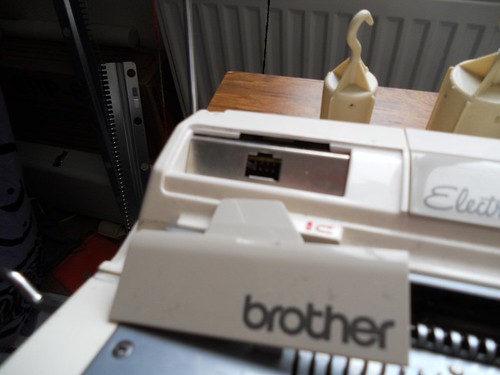
Any Brother electronic with i in the model name, has a special port which can be used to connect to both the Brother PPD (a programming device) and the modern Designaknit (DAK) software via a special cable. The KH950 and 965 came in both variants, and an upgrade kit could be bought to convert them to the i (replacing the whole electronics part and adding that extra port). 

Picture 035

The Brother KH950i socket

Picture 034

A PPD

Picture 033

PPD onscreen display

Picture 043

Floppy disk drive

Some Brother electronics came with cartridge ports. These are along the lines of the old console game systems - you could use the PPD to program the cartridge which has some memory in it, and then plug the cartridge into the machine. The PPD itself is basically a very early computer, with cursor keys and black and white buttons. It connected to a TV via the analogue aerial port, so you could create patterns on screen and save them to the cartridge - there are even rudimentary copy and paste functions, though it's very tricky without a mouse. There was also an additional disk drive (FB100) which used a very early 3.5" floppy disk format. I think it may have been possible to connect the FB100 directly to the knitting machine if it was an "i" model, otherwise you had to load the floppy disk designs onto the cartridge via the PPD. You could read designs TO and FROM the cartridge using a command line style screen, and you could also transfer patterns TO and FROM the knitting machine memory itself.

The KH965 is also on-the-fly programmable, ie black and white buttons and cursor keys. 

All of the later Brother machines had built-in libraries of stitch patterns, and they are programmed as if on a sheet of graph paper, exactly how they appear in the Stitchworld books. This means you can use part of a pattern, or even some of the pattern and the white space around it, to generate new patterns. These machines also had pattern variation buttons, allowing you to mirror, change the height and/or width, or invert the colours, and it's also possible to split a 2 colour pattern for double-bed jacquard. 

Silver (aka Knitmaster, Studio, Empisal, Singer depending on locale).

Silver machines were a lot more modular. They never came with built-in stitch libraries. Early ones had pattern variation buttons, eg reverse direction, double-width/height, mirror etc, that would work with mylar sheets that are very similar to the Brother ones except they are printed in red, not blue (and the start line is slightly different). The later ones (eg SK840) are completely "brainless" - the only electrical part about them is a cable and its socket on the carriage. This means that they need other additional devices to program them, otherwise any patterning is manual. 

The EC1 looks like an old dot matrix printer, except it reads 60st wide mylar sheets marked in pencil (this device reads shinyness). You ran it, powered, alongside your knitting machine. It has the variation buttons as above, and it's basically an electronic version of a punchcard, reading line by line as you knit. This could be further extended with the addition of a PE1 (Pattern Extender). This took a special memory card, which you could read and write to, and has a 5 line LCD display that meant you could double-check any pattern read into it from a mylar sheet. The PE1 is no use on its own, it only worked when plugged into the EC1. A later development was the short-lived PC10, which combined the EC1 and PE1 in one box - it also contained all the original Silver mylar sheets programmed in. However, a major downside was that there was no way to connect it to anything modern data-wise (eg USB or DAK) - the only media it took was an old compact flash card format. Needless to say, it flopped!

ec1

EC1

pe1

PE1

pc10

PC10

You can opt to send patterns only with a Silverknit box - this uses a small piece of software to transmit stitch patterns ONLY directly from your computer. You can also purchase a Silverlink cable - this is the cables to talk to DAK, plus a silver box which is the memory needed to store the information. This is why the Silverlink cable is more expensive than the cables for the other machines. 

I'm not going to cover Superba, Toyota or Passap/Pfaff here because I'm not familiar with them. The electronic machines can all be used with DAK as long as the correct cable is purchased; most punchcard machines can also work with DAK but only for garment shaping, the patterning remains mechanical. However, if you don't want to take the DAK route there are other options such as the AYAB board, arduino, Img2track and other "hacks". 

mk_patterning

This is a brief explanation of various options, the dotted line is because the PE1 is optional. Cables don't neccessarily download AND upload, it depends on the model.